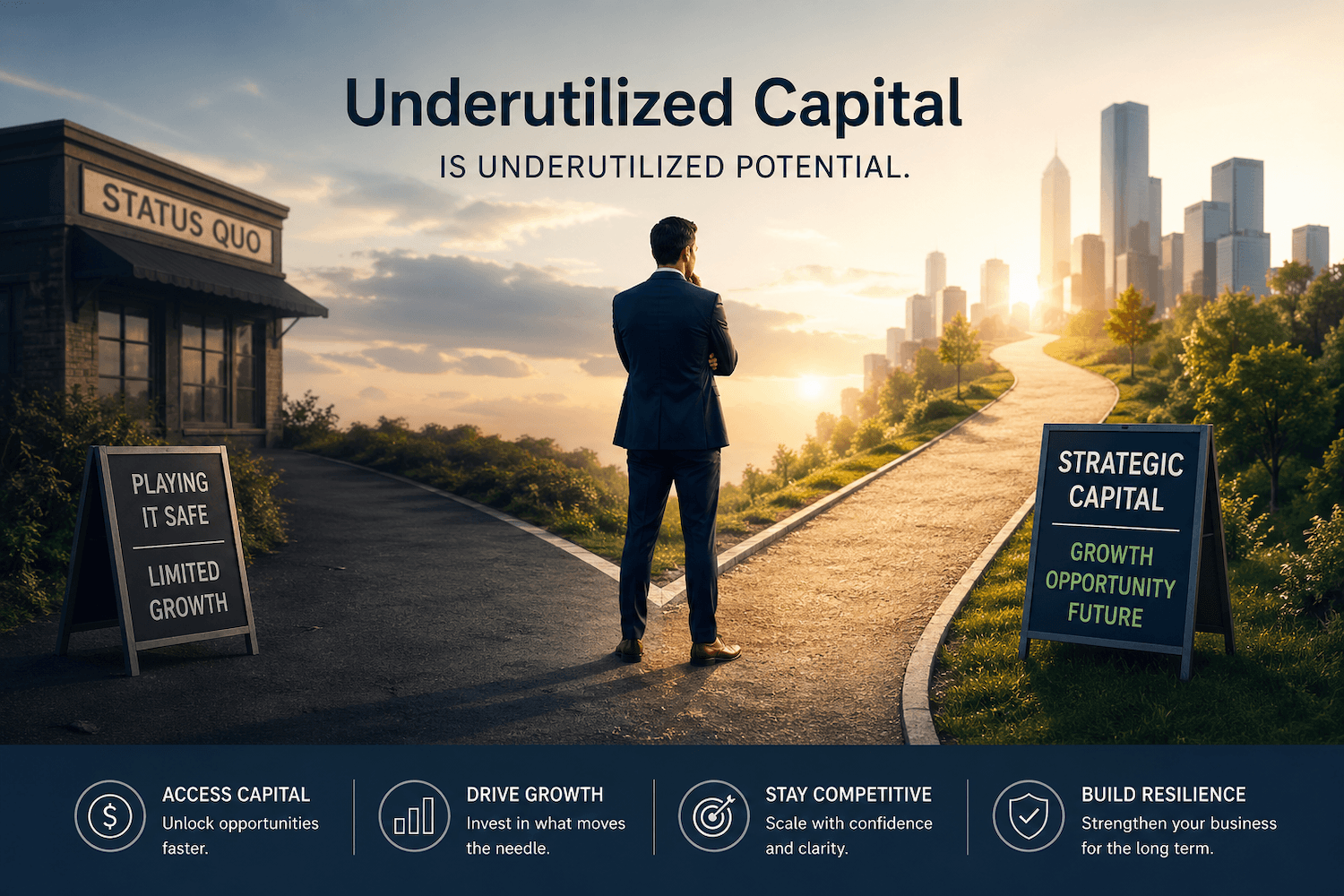
The Risk Most Businesses Don’t See
In business finance, risk is almost always framed in one direction: taking on too much debt.
Overleveraging is discussed at length – and for good reason. Poorly structured debt can strain cash flow and limit flexibility. But there is a less visible, often overlooked risk that can be just as damaging:
Not using enough capital.
The underutilized capital problem does not create immediate pressure. It does not trigger urgent decisions or obvious warning signs. Instead, it quietly limits growth, slows momentum, and keeps businesses operating below their potential.
From a lender’s perspective, some of the most constrained businesses are not those carrying too much debt – but those avoiding it entirely.
Can Not Borrowing Hurt Business Growth?
Yes – and in many cases, it does.
A business that relies solely on internally generated cash is inherently limited by its own pace of accumulation. Growth becomes tied to retained earnings rather than opportunity.
This creates a structural bottleneck.
Opportunities in business rarely align perfectly with available cash. Whether it is:
- Expanding into a new market
- Hiring ahead of demand
- Securing discounted inventory
- Investing in marketing or infrastructure
These decisions often require capital before returns are realized.
Without access to funding, businesses are forced to delay – or decline – these opportunities altogether.
Over time, this results in:
- Slower growth trajectories
- Lost market share
- Reduced competitive positioning
The cost of inaction is rarely calculated, but it is very real.
The Conservative Financing Mindset
Many business owners operate with a deeply ingrained belief: “Debt should be avoided whenever possible.”
This mindset is often shaped by personal financial principles, where minimizing debt is a sign of discipline.
However, business finance operates differently.
Debt, when structured correctly, is not inherently negative. It is a tool – one that can be used to generate returns that exceed its cost.
The issue is not caution itself. The issue is when caution becomes constraint.
Businesses that are overly conservative with financing tend to:
- Underinvest in growth initiatives
- Miss time-sensitive opportunities
- Operate reactively rather than strategically
In these cases, avoiding debt does not reduce risk – it shifts it into slower growth and diminished competitiveness.
Missed Growth Through Underinvestment
One of the most common outcomes of underutilized capital is underinvestment.
This typically shows up in subtle ways:
- Delaying hiring despite increasing demand
- Limiting inventory purchases due to cash constraints
- Reducing marketing spend during key growth periods
- Avoiding expansion despite proven market demand
Each decision may appear prudent in isolation. But collectively, they create a pattern of missed opportunity.
From a financial advisory standpoint, the question is not: “Can the business afford to borrow?”
It is: “Can the business afford not to?”
How Much Debt Is Healthy for a Business?
This is one of the most frequently asked questions – and one of the most misunderstood.
There is no universal number that defines the right level of debt. Instead, lenders evaluate capacity, not just quantity.
Key considerations include:
- Revenue consistency
- Cash flow stability
- Margin strength
- Existing obligations
The goal is to achieve an optimal capital structure, where debt supports growth without creating undue strain.
A healthy level of borrowing is one where:
- The return on capital exceeds the cost of financing
- Cash flow comfortably supports repayment
- The business maintains operational flexibility
In this context, debt is not a burden – it is a lever.
What Is Optimal Capital Structure?
Optimal capital structure refers to the balance between debt and equity that allows a business to operate efficiently while maximizing growth potential.
For most SMBs, this does not mean minimizing debt. It means using it strategically.
An optimized structure allows businesses to:
- Accelerate growth without waiting for retained earnings
- Maintain liquidity during expansion
- Improve return on equity
Businesses that avoid debt entirely often operate with suboptimal capital structures, limiting their ability to scale effectively.
Strategic Borrowing Thresholds
One of the most important distinctions in business funding is understanding how much to borrow – and when.
Borrowing too little can be just as ineffective as borrowing too much.
For example:
- Securing minimal funding may address immediate needs but fail to support broader growth
- Underfunded expansion efforts can stall midway, creating inefficiencies
- Insufficient working capital can limit the impact of otherwise strong revenue
Strategic borrowing involves aligning capital with actual business objectives, not just immediate gaps.
This is where experienced funding partners provide value – not just in access to capital, but in structuring it correctly.
Should SMBs Use More Leverage?
The better question is: Should SMBs use leverage more effectively?
Leverage, when applied thoughtfully, allows businesses to:
- Act on opportunities in real time
- Compete with larger, better-capitalized firms
- Smooth cash flow during growth phases
From a lender’s perspective, businesses that understand how to use leverage tend to:
- Grow faster
- Operate more efficiently
- Maintain stronger financial control
Avoiding leverage entirely often results in the opposite.
Capital Efficiency: Doing More With Access, Not Just Cash
Capital efficiency is not about minimizing spending – it is about maximizing output from available resources.
Businesses that rely solely on internal cash are limited by what they have. Businesses that leverage capital strategically are defined by what they can access.
This distinction is critical.
Access to capital allows for:
- Faster decision-making
- Greater operational flexibility
- More consistent execution
It transforms financing from a constraint into a competitive advantage.
How Do Businesses Decide How Much to Borrow?
Effective borrowing decisions are not based on fear or comfort – they are based on expected return and operational need.
This includes evaluating:
- The ROI of the intended use of funds
- The impact on cash flow
- The timing of revenue generation
- The overall financial structure
Forward Funding’s approach, reflected across its How to Grow section, emphasizes aligning capital with specific growth outcomes, rather than treating funding as a last resort.
Growth vs. Caution: Finding the Balance
The goal is not aggressive borrowing. It is informed borrowing.
Businesses that strike the right balance:
- Use capital to accelerate proven strategies
- Maintain visibility into cash flow and obligations
- Adjust financing as the business evolves
They are neither overleveraged nor underutilized.
They are optimized.
“Am I Being Too Conservative With My Business?“
This question often arises when growth begins to plateau despite strong fundamentals.
Signs of excessive conservatism may include:
- Consistent profitability but limited expansion
- Missed opportunities due to cash constraints
- Reluctance to invest despite clear ROI
In these cases, the issue is not financial health – it is capital strategy.
A More Complete View of Risk
Risk in business is not defined solely by debt levels.
It is defined by:
- Missed opportunities
- Slower growth
- Reduced competitiveness
Avoiding financing may feel safe – but it can introduce a different kind of risk: falling behind.
Closing Perspective: Capital as a Growth Engine
The most effective businesses do not ask whether they should borrow.
They ask: “How can capital be used to move the business forward?”
The answer is rarely zero.
When structured correctly, financing:
- Expands opportunity
- Improves efficiency
- Accelerates growth
The real risk is not always taking on too much capital.
Sometimes, it is not using enough of it.
Explore More Growth Strategies
For additional insights on leveraging capital, managing cash flow, and scaling effectively, explore Forward Funding’s How to Grow section – designed for Canadian businesses looking to grow with precision and control.
Additionally, you can speak with one of our funding experts at ForwardFunding.ca to explore funding options designed for real-world business conditions. You can also explore our Google Reviews to see firsthand the level of service and support that Forward Funding consistently delivers.
Fast FAQ’s – Business Borrowing & Capital Strategy
Can not borrowing hurt business growth?
Yes. Without access to capital, businesses may miss opportunities, delay expansion, and grow more slowly than competitors.
How much debt is healthy for a business?
It depends on cash flow, revenue stability, and ROI. Healthy debt supports growth without straining operations.
Should SMBs use more leverage?
SMBs should use leverage strategically to support growth and improve capital efficiency.
What is optimal capital structure?
It is the right balance of debt and equity that maximizes growth while maintaining financial stability.
How do businesses decide how much to borrow?
They evaluate return on investment, cash flow impact, and overall financial structure.
Can avoiding loans hurt my business?
Yes. Avoiding financing can limit growth, reduce flexibility, and create missed opportunities.